Primary Care: The Front Door to a Very Large Healthcare System
- Jul 8
- 4 min read
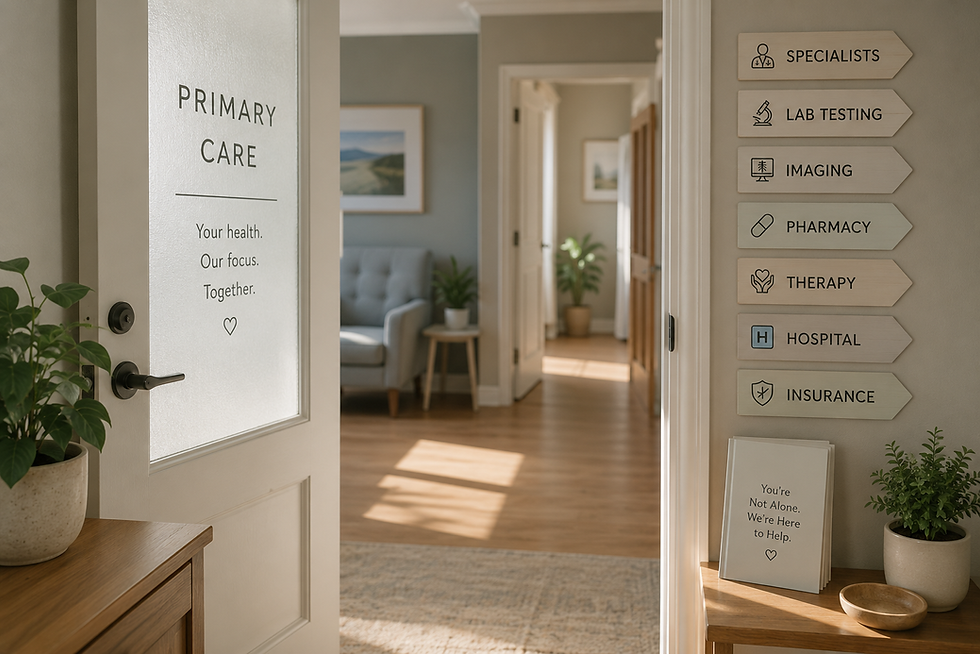
In my first blog post(you can read it here), I shared an idea that surprises many people:
Healthcare isn't one seamless, connected system.
It's a collection of different parts—primary care, specialists, hospitals, pharmacies, insurance companies, support services, and more—all trying to work together.
Sometimes they do.
Sometimes they don't.
And when those pieces don't connect as smoothly as we'd hope, patients and families often find themselves trying to hold everything together.
Over the next several weeks, I want to slow down and look at each of these pieces individually.
We'll start with the place where most healthcare journeys begin:
Primary care.
More Than an Annual Physical
If healthcare were a city, primary care would be the front door.
It's usually the first place people go when something doesn't feel quite right. It's also the place people return to year after year for routine checkups, preventive care, chronic disease management, medication refills, and the hundreds of little questions that don't clearly belong anywhere else.
Primary care providers are often described as the "jack of all trades" in medicine.
I think that's one of the most accurate descriptions there is.
Unlike specialists, who spend years focusing on one organ system or one type of disease, primary care providers need to know a little about almost everything. One appointment might involve high blood pressure. The next might be depression, diabetes, a lingering cough, knee pain, or helping someone decide whether they even need to see a specialist.
Their job isn't to know everything.
Their job is to recognize patterns, identify concerns early, manage common health conditions, and help guide people through the larger healthcare system when more specialized care is needed.
They're often the first stop—but they're rarely the only stop.
Why Primary Care Can Feel Frustrating
If you've ever left a primary care appointment thinking, "That felt fast," you're not imagining it.
Many primary care providers care deeply about the people they serve. They want to answer questions, explain diagnoses, and build relationships over time.
But they are also working within a system that asks an enormous amount of them.
Many providers are responsible for caring for two to three thousand patients.
Appointments may only last fifteen or twenty minutes.
During that short visit, they're reviewing medications, addressing today's concerns, ordering appropriate testing, documenting everything in the medical record, managing preventive care, responding to prescription refill requests, reviewing lab results, answering patient portal messages, and preparing for the next person waiting down the hall.
Understanding those realities doesn't erase the frustration patients sometimes feel.
But it helps explain why appointments can feel rushed, even when no one intended them to.
The Experience From the Other Side of the Exam Table
Now let's look at the appointment from your perspective.
Maybe you've been waiting weeks to be seen.
You've spent days thinking about your symptoms.
You've practiced how you're going to explain what's been happening because you don't want to leave anything out.
Then the visit begins.
You answer questions. The provider asks follow-up questions. There's an exam. Lab work is discussed. Maybe medications are adjusted. Maybe a referral is recommended.
Before you know it, the visit is over.
As you're walking back to your car, you suddenly remember the question you meant to ask.
Or maybe you think, I don't actually know what happens next.
Or perhaps you leave wondering if you explained yourself clearly enough.
These experiences are incredibly common.
Not because you're unprepared.
Not because your provider doesn't care.
But because healthcare asks people to process a tremendous amount of information in a very short amount of time—often while they're worried, uncomfortable, or simply trying to understand what's happening to their body.
What a Good Primary Care Relationship Feels Like
People often ask me how to find a "good" primary care provider.
There isn't one perfect answer because every person values something a little differently.
But I think there are a few things worth paying attention to.
A good primary care provider listens before jumping to conclusions.
They explain things in language you understand.
They welcome questions instead of making you feel rushed or embarrassed for asking them.
Perhaps most importantly, they create an environment where you feel safe being honest.
Healthcare works best when people can say things like:
"I stopped taking that medication because of the side effects."
"I couldn't afford to fill that prescription."
"I don't really understand what this diagnosis means."
"I'm overwhelmed."
Those conversations only happen when trust exists.
If you consistently leave appointments feeling dismissed, shamed, or afraid to speak openly, it's okay to ask whether that relationship is meeting your needs.
Finding a primary care provider is about more than finding someone with the right credentials.
It's about finding someone you can build a relationship with over time.
Making the Most of Your Visit
While no appointment will ever feel perfect, there are a few simple things that can make visits more productive.
Write your questions down beforehand instead of relying on memory.
Think about the two or three concerns that matter most to you if time becomes limited.
Bring an updated medication list.
Before you leave, ask one simple question:
"What happens next?"
Who schedules the imaging?
Will someone call with lab results?
Should you schedule the follow-up appointment, or will the office contact you?
Finally, don't be afraid to say:
"Just to make sure I understand..."
Repeating the plan back in your own words gives everyone an opportunity to clarify misunderstandings before you walk out the door.
Primary Care Is One Piece of the Puzzle
Primary care plays an incredibly important role in healthcare, but it isn't the entire healthcare system.
There are still specialists, hospitals, pharmacies, insurance companies, therapists, home health agencies, and many other moving parts that influence a person's care.
Understanding what primary care is—and what it isn't—can make navigating healthcare feel a little less confusing. Because once you begin to see how each part of the system fits together, it's easier to understand why healthcare sometimes feels so complicated in the first place.
And that's exactly why I'm writing this series.
Not to teach you medicine.
But to help make the healthcare system a little easier to understand, one piece at a time.


Comments